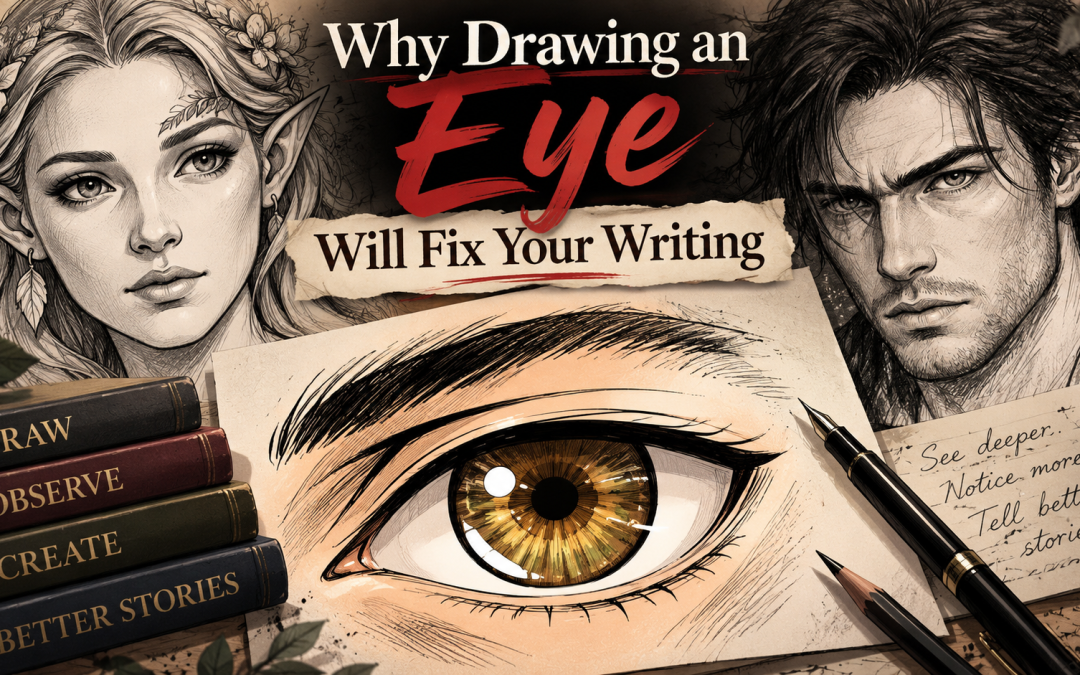
If you ask a beginner to draw a human eye, they will almost always draw the same thing: an almond shape, a circle squeezed inside it, a smaller black circle in the center, and a row of stiff lashes lining the top lid.
It is recognizable, but it is dead. It reads like Egyptian Hieroglyphics -- a symbol for an eye rather than an eye itself.
To make an eye look alive on paper, you must forget the symbol and start rendering perception. You must add the shadow cast by the upper lid, the wetness pooling along the lower waterline, the translucent depth of the iris, and, above all, the catchlight—that tiny, bright speck of white where the light source reflects off the eye’s curved surface. Without that speck of reflected light, the drawing remains a flat oval It has no depth, no glare, no soul.
In fiction, Point of View (POV) operates on the exact same principle. Plot is merely the almond shaped outline; Point of View is the light reflecting in the iris. Too often, novice drafts suffer from the literary equivalent of a glass eye: a narrator who mechanically records events—I saw, he looked, she heard—without ever letting the light of interiority strike the lens.
If eyes are the window to the soul, then a story’s POV is the window through which we view its world. Understanding how an artist draws an eye offers a masterclass in how a writer focuses narrative perspective.

Pin This Post
1. The Cornea and Narrative Bias (First-Person POV)
When an artist draws an eye up close, they don't just draw the iris; they draw what the eye is looking at, faintly mirrored across its glossy surface.
This is First-Person POV at its best. A story written in the first person I/We isn't just about what a character witnesses—it is about how their lens warps the sight. Light does not enter the human eye in a clean, uncorrupted line; it refracts through the cornea. Similarly, facts should never enter a first-person narrative cleanly.
If your protagonist is a grieving carpenter entering an old house, they don't simply see "a living room." Their lens filters reality through their specific grief and their trade: they notice the dry rot in the baseboards, the squeak of ungreased hinges, the dust settling on a chair where no one sits anymore. First-person POV is the mirror on the cornea: by showing us the world through their refraction, we see the soul standing behind the glass.
2. The Catchlight and Interiority (Third-Person Limited)
In Third-Person Limited He/She/They, the camera sits just over the character’s shoulder. The danger here is falling into a security-camera style of prose: Arthur walked into the kitchen. He opened the fridge. He felt sad. This is the drawn eye without a catchlight—technically complete, but spiritually hollow.
The catchlight in Third-Person Limited is interiority—the tiny, sharp glint of voice, subtext, and emotional resonance. It is the moment where objective physical description gives way to subjective experience:
Arthur opened the fridge. The cold air hit his face, smelling faintly of old milk and forgotten promises.
With one detail, light hits the pupil. We aren't just watching Arthur standing in a kitchen; we are looking out from behind his eyes. The writer’s job in Third Person Limited is to constantly calibrate the "pupil dilation"—knowing when to widen the lens for sweeping external observation and when to contract it down to hyper-focused, emotionally charged detail.
3. Depth of Field and the Omniscient Eye
In visual art, if every element in a portrait is drawn with equal sharpness, the image feels overwhelming and artificial. An artist must choose a depth of field—focusing crisply on the iris while letting the ear, the hair, and the background blur soft.
Third-Person Omniscient is often misunderstood as an "all-seeing" POV that must report everything. But an omniscient narrator isn't an unfeeling security grid; it is the master artist controlling the light across the entire canvas. The omniscient voice can peer into one character’s eyes, highlight a secret fear, and then smoothly shift focus to the person sitting across the table, revealing how terribly they have misread each other. The power of omniscience isn't seeing all windows at once—it’s knowing which window to illuminate at any given second. (This is what you see in Comics)
The Glass Eye Fallacy: Filtering vs. Experiencing
When a drawn eye looks unnatural, it’s usually because the artist over-rendered the outlines, making the borders too harsh. In prose, this happens through filtering verbs:
-
She saw the door open.
-
He felt his hands shaking.
-
She heard the bell chime.
Filtering acts like a layer of dusty glass placed between the reader and the story. It reminds us that we are watching someone else watch something. To pull the reader directly into the eye socket, erase the outline:
-
The door swung open.
-
His hands shook.
-
The bell chimed.
By removing the extra step of processing, the reader stops looking at the character and starts looking through them.
The Unbroken Reflection
A drawing of an eye becomes convincing the moment the artist stops drawing what they think an eye looks like and starts observing how light actually behaves.
Writerly craft requires the exact same shift. A story comes alive not when you plot out what happens next, but when you decide whose eyes are watching, how their pupil dilates in response to fear or love, and where the light source strikes the iris.
Don't just build the window. Show us the reflection in the glass.