We have a toxic relationship with talent.
When we see someone execute a flawless piece of art, write an effortless chapter of prose, or design a complex system, we default to a comforting lie: They are so talented.
We tell ourselves this story because it protects us. If skill is an innate gift, then our awkward first attempts aren't stepping stones—they’re proof that we just don't have "it."
I spent at least fifty years drawing in the margins of my life. I earned a degree in applied physics and built a career outside of art. I never went to art school. But over the decades of filling sketchbooks late at night, I stumbled onto a law of skill acquisition that applies to writing, drawing, and virtually every creative endeavor:
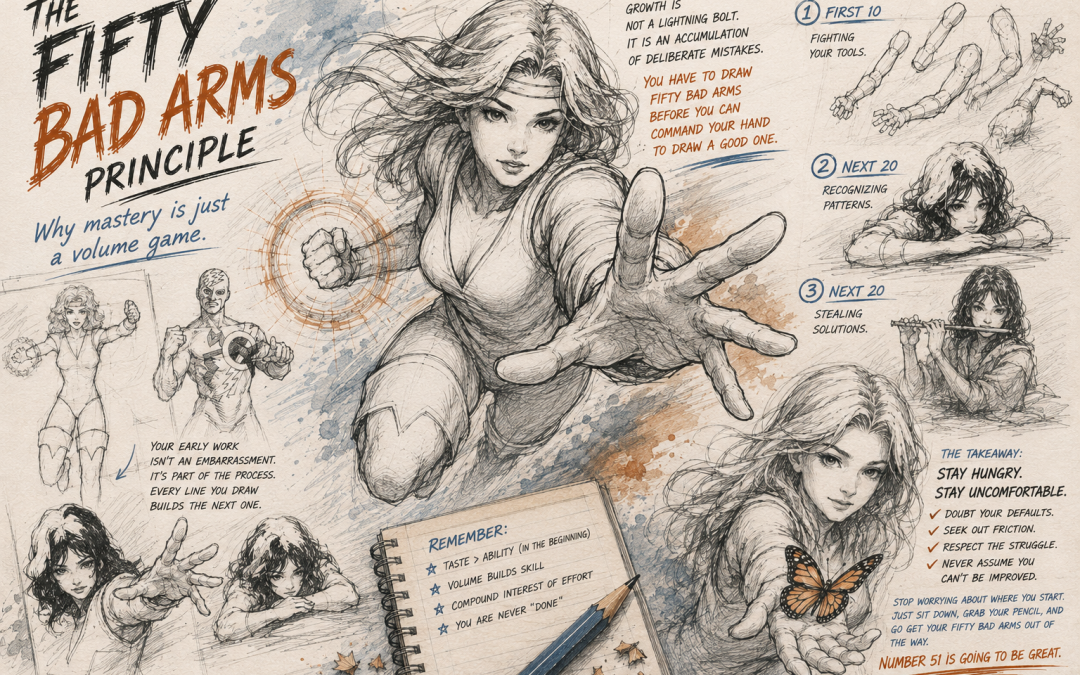
Growth is not a lightning bolt. It is an accumulation of deliberate mistakes. You have to draw fifty bad arms before you can command your hand to draw a good one.
If you want to build a creative practice that lasts, you have to change how you look at your "bad" work.

Pin This Post
1. The Gap Is Real (And It’s Supposed to Hurt)
When you start out as a beginner, your taste is always better than your ability.
You can recognize great line work, compelling dialogue, or brilliant lighting in someone else's creation. But when you try to produce it yourself, the output is clunky and stiff.
In my teens I drew superheroes, fantasy characters, creatures and fantastic objects. In my head, they were dynamic and powerful. On the paper they didn’t quite meet the mark.
That gap between expectation and reality causes most people to quit. They draw three "bad arms," feel the sting of frustration, and put the pencil down for good.
The trick isn't eliminating the gap; it's realizing that the discomfort of the gap is where the learning happens. The frustration is just your brain registering the difference between where you are and where you want to be.

2. You Can’t Out-Think the Reps
Coming from a technical background, my instinct is logic. You analyze, measure, and break down problems structurally. But intellect cannot bypass the muscle-memory tax.
You cannot read a book about art and instantly create a master piece. You cannot a book about storytelling and immediately write a bestseller in your first draft. You have to put in the raw, unglamorous volume.
The First 10 "Bad Arms": You are fighting your tools. Your hands don't do what your brain want.
The Next 20 "Bad Arms": You start recognizing patterns. You notice where the muscle attaches or where the shading breaks, even if you can't fix it in real-time yet but you do get better at editing.
The Next 20 "Bad Arms": You begin stealing solutions from creators you admire—and even creators whose skill frustrates you because they make it look so effortless. You build a mental "Brain Bank" of appropriate shapes you found to look good.
Then, on attempt fifty-one, you draw an arm without overthinking it. It flows. The lines are confident, the weight is balanced, and the foreshortening works.
It feels like magic, but it isn't. It’s just compounding interest on other failed attempts.

3. Reaffirm Yourself to the Struggle: You Never Truly "Arrive"
Recently, I sat down to recreate that 15-year-old superhero sketch from scratch. Four decades of accrued "reps" went into the new drawing: explosive energy, dynamic line weight, foreshortened perspective, and atmospheric depth.
It would be easy to look at a transformation like that, pat myself on the back, and say, "There. I’ve made it. I’ve mastered this."
That mindset is a trap.
The moment you assume you’re "right," that your technique is perfected, or that you’ve reached the peak of your craft, your growth dies. Mastery isn't a destination where you get to park and put your feet up—it’s an ongoing commitment to the struggle of learning.
Even while drawing today, I catch myself fighting with arms, poses and any number of things that just look awkward. I have to actively stop, challenge my own assumptions about the pose, and force myself to rework it so it actually functions.
You are never too experienced to be wrong. You are never too advanced to learn something new from a beginner, try a style that makes you uncomfortable, or completely tear down a piece of work and rebuild it.
Your early work isn't an embarrassment to hide, and your current work isn't a trophy to coast on. Both are just pit stops in an endless process of refining your eye and your hand.

The Takeaway: Stay Hungry, Stay Uncomfortable
Whether you are holding a pencil, drafting chapter one of a novel, or picking up a brand-new craft later in life, drop the expectation of ever "arriving."
The goal isn't to reach a point where creating is effortless; the goal is to keep raising the bar so that creating stays challenging.
Doubt your defaults. Question the habits and shortcuts you rely on out of comfort.
Seek out friction. If a pose, a scene, or a technique feels intimidating, that’s precisely what you should tackle next.
Respect the struggle. The feeling of being tested isn't a sign that you’re failing—it’s the only proof that you are actively growing.
Never assume you can't be improved. Welcome the hard work, clear off your desk, and go get your next fifty bad arms out of the way. Maybe it’s feet now. I always hated drawing feet.
Stop worrying about where you start. Stop worrying about whether you have formal credentials or "talent." Just sit down, grab your pencil, and go get your fifty bad arms out of the way. Number 51 is going to be great.