
Every author knows that characters evolve over time. The person who appears in Chapter One is rarely the exact same person who steps out of Chapter Thirty. But there is a massive difference between a character who grows organically through story events and a character who floats through a draft like a intangible ghost because the writer never knew who they were in the first place.
If you don't have a firm handle on your character before you start putting words on paper, they are going to land flat, wooden, and forgettable.
And no—knowing that your protagonist is six feet tall with messy brown hair and a moody disposition isn't "knowing" them. Physical descriptions and basic tropes are just silhouette cutouts. To make a character jump off the page, you have to be able to see them clearly in your mind's eye as a complete, living person.

Pin This Post
Beyond the Surface: What Driven Characters Are Made Of
Knowing a character means understanding the internal engine that powers every decision they make. It comes down to four core layers:
• What Drives Them Now: What is their non-negotiable goal? What do they want more than anything else in the world, and what are they terrified of losing?
• How They React Under Pressure: When a crisis hits, do they freeze, joke, take charge, or panic? Pressure doesn't change who a character is—it reveals them.
• Mannerisms and Quirks: Do they have a subtle habit when they're lying? A specific catchphrase they use when nervous? An annoying habit of tapping their fingers on the table?
• Unspoken History: You need to know their secrets, their formative failures, and their deeply held fears.
You won't spell out all of these details in the actual narrative. In fact, info-dumping a character’s entire backstory in Chapter Two is a great way to kill your story's momentum. But having those answers locked in your head changes everything. It silently colors how they walk into a room, how they speak in dialogue, and—most importantly—the decisions they make when backed into a corner.
My TTRPG Rule: Who They Are Before What They Can Do
This principle isn't just for novel writing. In the tabletop role-playing games I run, I always ask players for their character conception first.
Before we ever look at character sheets, assign stats, or pick flashy powers and combat abilities, we figure out who is this person. What is their background? What motivates them to leave home and face danger? How do they view the world?
Only after we establish who they are do we fill in what they can do. Why? Because a character's stats don't solve problems—the person does. Knowing who a character is at their core gives you the best, most authentic determination of how they will handle conflict when things go completely off the rails.
If you don't know who they are first, high stats just make for a boring hero. But when you know who they are, even a failed roll or a terrible mistake becomes incredible storytelling.
The "Who Are They?" Pre-Draft Checklist
Before you write your next scene, run your character through this quick checklist. If you can answer these questions without pausing, you're ready to write or play. This holds true for every character, side character and villains.
• Core Motivation: What is the single thing this character wants right now?
• The Fear: What is the one thing they are desperately trying to avoid or hide?
• The Pressure Valve: How do they react when pushed to their emotional limit? (Do they lash out, shut down, over-analyze, or defuse with humor?)
• The Physical Trait: What is their subtle, subconscious physical habit when uncomfortable or lying? What is their unconscious behavior?
• The Moral Line: What is one line they swear they will never cross—and what would force them to break it? (For a villain that line has already been broken.”
• The Voice: What words, slang, or cadence do they use that no other character in your cast would use?
• The Relationship Anchor: Who is the one person whose opinion actually matters to them?
When you can see the answers to these questions clearly in your mind, your character ceases to be lines of text on a screen. They become real—and your readers will feel it on every single page.

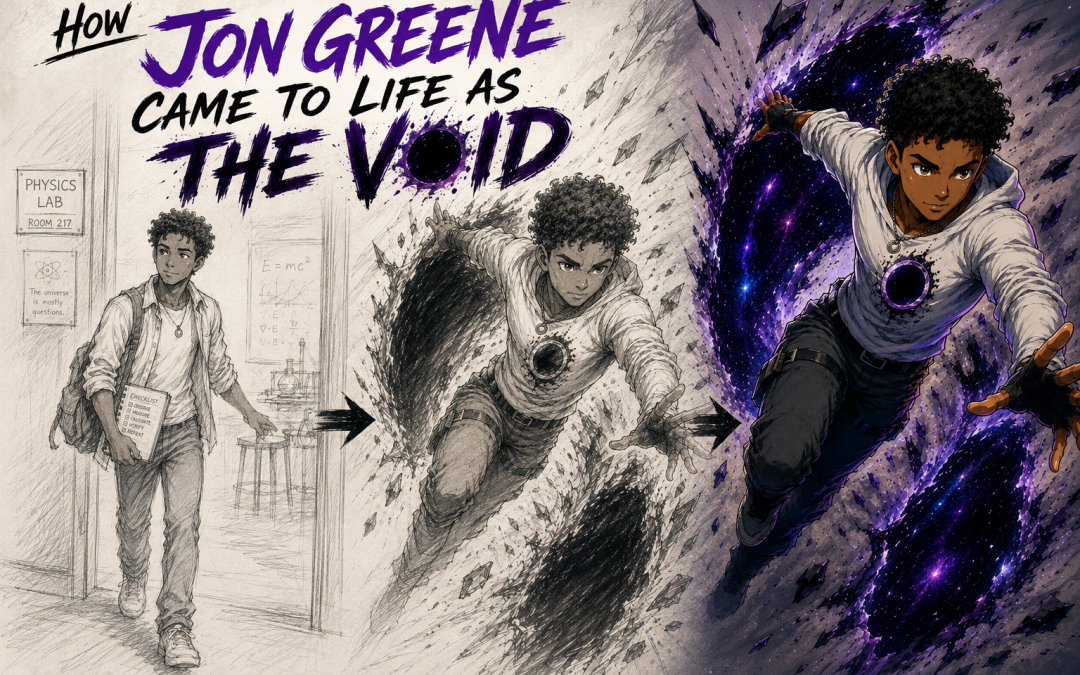
Case Study: How Jon Greene Came to Life as The Void
To see how this works in practice, look at a character I created back in the mid-1990s named Jon Greene.
On the surface, Jon had a fun, distinct pitch: he was a happy, easy-going college student from Jamaica (heavily inspired by watching Cool Runnings) who ended up gaining the power of teleportation.
"Jamaican teleporter" where he turns into a hole between the two locations sounds like a cool concept, but that alone isn't enough to create a compelling character. What made Jon real were the internal layers under the hood:
• The Core Motivation: Jon was a natural jack-of-all-trades, a trait by his parents working all the time but cultivated by his college physics mentor, Dr. Angela Black. But during a lab accident involving dark matter research, Jon’s negligence caused an explosion. It granted him his teleportation powers, but it left Angela in a coma. From that second on, Jon’s entire life changed. He was driven by a desperate goal: support his mentor and find a way to cure her.
• The Internal Shift: That single traumatic mistake completely reshaped his personality. The easy-going kid became a meticulous, checklist-obsessed person. He was terrified of making another mistake and getting someone else hurt.
• The Flaws & Quirks: Put him under pressure, and he’d overreact. Try to make him lie, and he couldn't do it—he’d stutter, pause, and completely fall apart.
• The Relationship Anchor: Everything he did was colored by his deep desire for Angela to wake up and still hold a positive opinion of him.
Because I knew who Jon was—his guilt, his fears, his moral lines, and his voice—playing him was effortless. Every decision he made flowed naturally from his backstory. You can easily see where each piece of that checklist was covered.
The real magic happened later in the campaign when I told the Game Master I wanted Jon to temporarily lose his teleportation powers. Because we had spent so much time establishing who he was before he had powers, stripping those powers away didn't break the character—it elevated him. He had to rely strictly on his original jack-of-all-trades resourcefulness and sheer heart to solve problems. That’s when the story hit the next level.
One day, I’ll write down all of Jon's adventures. But he only worked in the first place because he was a complete person in my head before he ever took a single step in the game or on the page.


Possible Excerpt From Jon’s POV
“Alright, easy now. Check the exits. Check the civilians. Check the bad man with the gun. Check the exits again, because apparently we learn things the hard way.
Three dudes. Two guns. One hostage.
No problem mon.
…Dat’s a lie. Definite problem.
Every problem have solution, yeah? Dr. Black always say, understand the system before you interfere with it.
So.
Dude by the door, he watching me. Dude by the window, he watching money. Other dude watching the hostage.
Not one watching the ceiling.
Good.
Open one hole above me. One behind Mister Doorway. Step through, take him down. Second hole under the gun. Let gravity handle dat one. Third dude probably panic.
Dey always panic.
N'cluding me.
S'pecially me.
But panic is just your brain giving you information too fast.
Slow down, Jon.
Measure twice.
Move once.
And please, for the love of God, do not accidentally teleport anybody into a wall.
Right.
Checklist done.
Time fi go to work.”







Brilliant stuff…plus who would want to miss rage adventure of truly knowing these people?