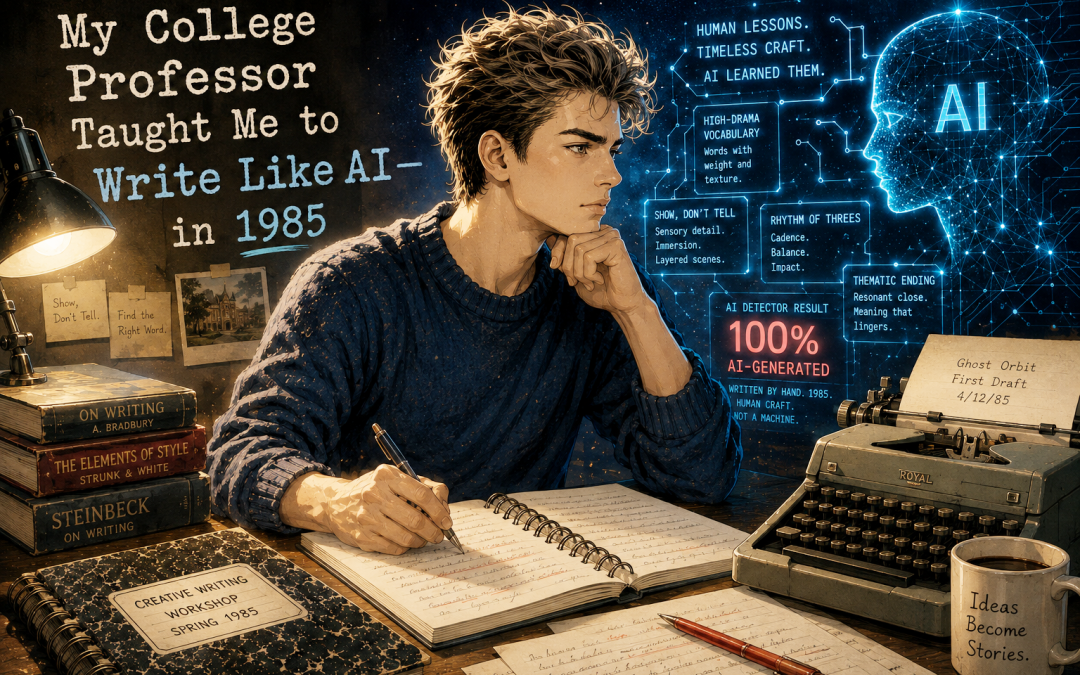
If you run my short story Ghost Orbit through a modern AI detector, the results are almost unanimous: 100% AI-generated.
According to these algorithms, my prose was forged in a digital furnace by an advanced machine learning model. There’s just one small problem: I wrote Ghost Orbit by hand in a spiral notebook during a college creative writing class in 1985. It went through several rounds of red-lined rewrites, long before consumer internet, let alone ChatGPT, was even a sci-fi dream.
So how did a hand-written story from four decades ago become "100% synthetic text"?
Because in 1985, my creative writing professor taught us how to polish our prose using the exact gold-standard techniques that large language models would eventually be trained to mimic. Modern algorithms didn't invent "AI style." They just absorbed centuries of human literary training—and now, the very techniques we were graded on are being treated like proof of a crime and the start of a witch hunt.


The "AI-Isms" of 1985
When LLMs were built, they were fed mountains of human writing, including classic literature, academic papers, and creative fiction. They learned that "good writing" follows specific cadence, structure, and vocabulary patterns that engage the reader.
Looking back at Ghost Orbit, it's crammed full of choices that were heavily praised by my professor in 1985—choices that will get you accused of prompt engineering today.
1. The High-Drama Vocabulary
In class, we were told to abandon plain, functional words. We were urged to find verbs and nouns that carried atmospheric weight.
• 1985 Lesson: Don't write that something reminded him of the past; write that it was a testament to it. Paint the scene using words that carry texture.
• The Modern AI Parallel: AI models love words like tapestry, testament, crescendo, whisper, echo, beacon, and illuminate. When an algorithm sees these high-value vocabulary words stacked together, its statistical smoke alarm goes off.
2. Over-Deliberate "Show, Don't Tell"
We were taught that every scene needed layer upon layer of sensory grounding. If a character was sitting in a cockpit or a quiet room, the reader needed to feel the cold metal, hear the hum of the engine, and sense the weight of the silence.
• 1985 Lesson: Stack sensory details to create immersive atmosphere.
• The Modern AI Parallel: AI often over-decorates sentences to ensure a scene feels "evocative." When a human writer does the same thing out of genuine artistic passion, the detector mistakes craft for an algorithm trying too hard.
3. The Rhythm of Threes
My professor loved rhythm. One of the classic techniques for creating dramatic weight was the parallel triplet—grouping descriptions or actions in precise sets of three.
• 1985 Lesson: "He looked at the dying instruments, the empty void outside, and the quiet shadow of what he’d left behind."
• The Modern AI Parallel: LLMs rely heavily on the rule of threes to construct balanced, pleasant-sounding prose cadence. If your draft has too many rhythmic triplets, the software flags it as predictable.
4. The Wrapping-Paper Ending
In 1985, a vignette or short story couldn't just end on a raw action beat. It needed a final, reflective sentence—a moment where the prose pulled back to offer a quiet, philosophical summary of the scene's emotional core.
• 1985 Lesson: End on a resonant, thematic note.
• The Modern AI Parallel: This is the ultimate "ChatGPT bow." Modern AI almost obsessively tries to summarize the moral or emotional weight of a passage in its closing lines.
The Absurdity of the Detector
Out of all the detectors I ran Ghost Orbit through, only a couple rightfully flagged it as human. The rest confidently declared it artificial.
And that exposes the fundamental absurdity of the current "AI witch hunt."
AI detectors do not search for digital watermarks or magical robot dust. They measure predictability and cadence (often called perplexity and burstiness). If a piece of writing is clean, highly structured, well-punctuated, and follows classical rules of rhythm and vocabulary, the software assumes a human couldn't possibly have written it.
It is profoundly ironic that people are using AI tools—which are notoriously unreliable guessing machines—to police human authenticity. Expecting an AI detector to prove whether a piece of art came from a human heart is like using a tape measure to weigh a shadow.


The Takeaway
If your writing is being flagged as "AI," take a step back and breathe.
You didn't write like a machine; the machines were trained to write like you. They stole the cadence of human craft, the lessons of university workshops, and the rhythmic quirks of hand-written drafts from 1985.
Don't flatten your style or break your prose just to fool a broken algorithm. Keep polishing your craft, trust your process, and remember that real readers care about the soul of the story—not the score on a snake-oil detection site.