10 Common Mistakes Writers Make When Writing Men
We've all met him before.
The six-foot-four billionaire surgeon who communicates like a therapist, smells like cedarwood after a sixteen-hour shift, never loses an argument, and exists solely to worship the heroine.
Just as male writers often fall into predictable traps when writing women, female writers and writers working heavily within romance, drama, and fantasy genres sometimes create male characters who feel more like fantasies, archetypes, or wish fulfillment than actual people.
The problem isn't that these characters possess attractive traits. The problem is that those traits are often exaggerated until the character stops feeling human.
If you want your male characters to feel authentic rather than manufactured, here are ten common mistakes to avoid.
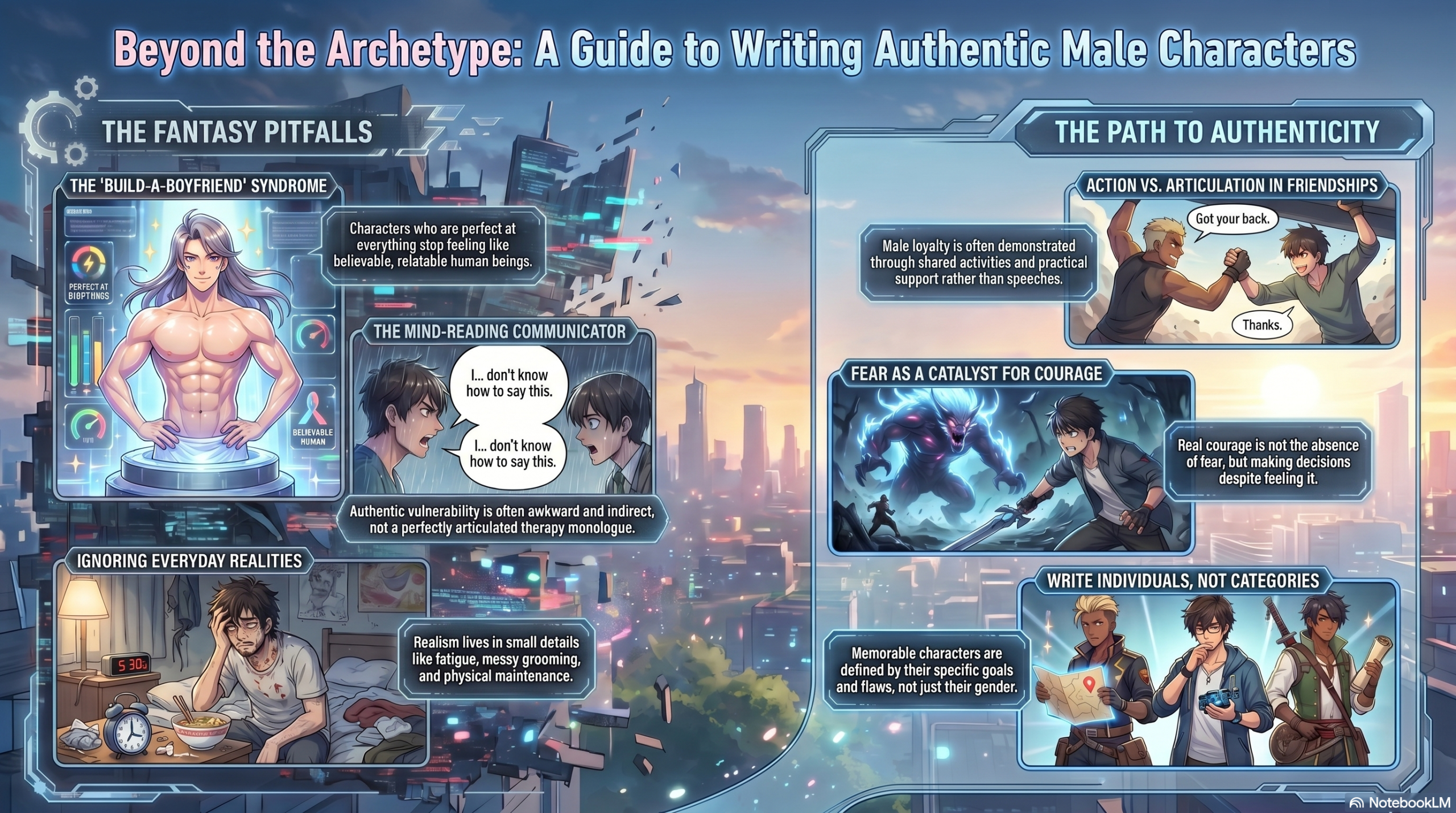
1. The Mind-Reading Communicator
Many stories feature men who possess near-supernatural emotional awareness.
On a first date, they instantly recognize their deepest childhood wounds, perfectly articulate every emotional nuance, and deliver uninterrupted monologues about vulnerability that sound like they were edited by a therapist and a poet.
The issue isn't that men discuss emotions. Many do.
The issue is that genuine vulnerability is often awkward, incomplete, indirect, or difficult to express. People rarely understand themselves as clearly as fictional characters sometimes do.
A believable man may struggle to explain what he's feeling, reveal pieces of the truth gradually, or express emotions through actions before he finds the words.
2. The Mindless Primal Beast
At the opposite extreme is the man who appears to be governed entirely by instinct and testosterone.
His jaw clenches.
His fists tighten.
A growl rumbles in his throat.
Every inconvenience triggers aggression, every attractive woman causes immediate loss of self-control, and every conflict ends with property damage.
The problem isn't that men experience anger or aggression. The problem is treating aggression as their only emotional setting.
Most adult men possess impulse control, emotional range, and the ability to navigate life without acting like territorial predators.
3. The Constant Masculinity Monologue
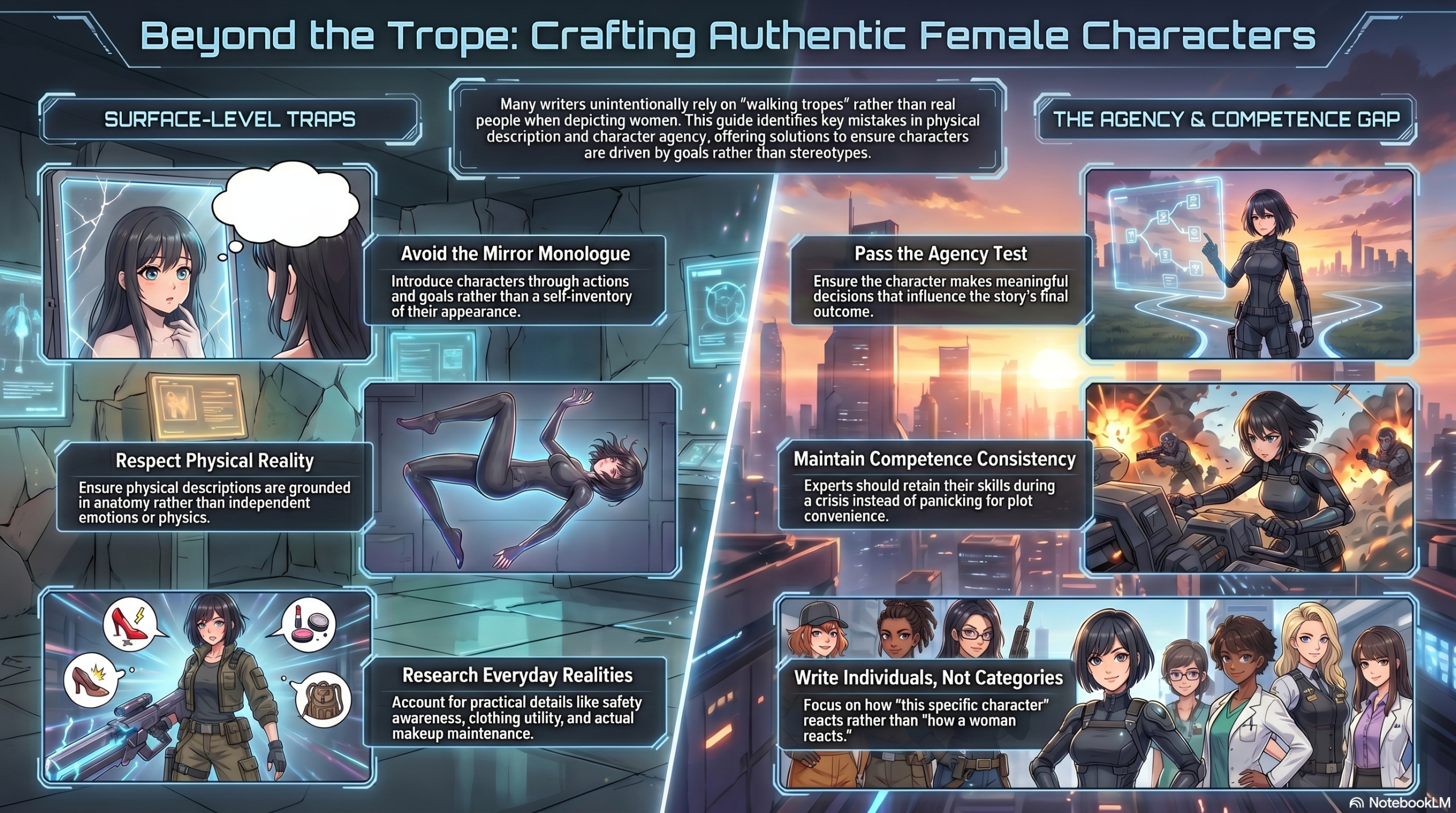
Just as poorly written female characters often spend pages analyzing their own appearance, poorly written male characters frequently obsess over their own masculinity.
He notices the breadth of his shoulders.
He admires the power of his chest.
He thinks about how much larger he is than everyone else.
Every room becomes an opportunity to evaluate his dominance.
In reality, most men aren't constantly narrating their own manliness. They're usually focused on whatever problem, task, goal, or distraction is directly in front of them.
Masculinity may influence how a character sees the world, but it rarely becomes the sole subject of his internal monologue.
4. The Wounded Bad Boy Excuse
This is the classic "I can fix him" character.
He's rude, cruel, manipulative, or emotionally unavailable. The narrative then reveals a tragic event from his past and treats that revelation as a complete explanation for his behavior.
Trauma can absolutely shape people.
It can make them fearful, guarded, angry, withdrawn, or self-destructive.
But trauma is not a substitute for character development.
A painful backstory may explain someone's behavior, but it doesn't automatically make that behavior attractive, interesting, or excusable.
5. Misunderstanding Male Friendship
Many stories portray groups of men as either hyper-aggressive competitors or emotional support groups that happen to be wearing football jerseys.
The reality is usually somewhere in between.
Male friendships often involve shared activities, practical support, teasing as a form of affection, and loyalty that may be demonstrated more through actions than lengthy emotional conversations.
A man helping his friend move across town at six in the morning may be expressing the same loyalty another character expresses through a heartfelt speech.
Neither approach is more authentic than the other.
The mistake is assuming there is only one way men connect.
6. The Personality-Free Nice Guy
In an effort to create a safe, healthy romantic partner, some writers accidentally remove everything that makes a character interesting.
This man has no strong opinions.
No boundaries.
No ambitions.
No meaningful friendships.
No hobbies.
No goals beyond supporting the protagonist.
He never disagrees, never challenges, and never creates friction.
Healthy relationships do not require personality-free partners.
A good partner can still have flaws, preferences, dreams, and independent priorities.
In fact, those qualities usually make the relationship more believable.
7. Ignoring Everyday Male Realities
Sometimes writers accidentally reveal a lack of familiarity with everyday male experiences.
The mechanic finishes a twelve-hour shift and somehow still smells like expensive cologne.
The construction worker has perfectly sculpted abs regardless of diet, age, sleep schedule, or body fat percentage.
The beard remains perfectly maintained without effort and never becomes itchy, uneven, or irritating.
These details may seem minor, but authenticity often lives in the small things.
Just as writers should research experiences common to women, they should also understand the realities of grooming, aging, fatigue, injury, body image, and physical maintenance for men.
8. The Fearless Action Figure
Some stories treat male characters as if fear simply doesn't exist.
The protagonist casually walks into a dangerous situation without considering consequences, risk, or potential failure.
He agrees to meet unstable strangers alone in isolated locations.
He confronts armed criminals without hesitation.
He never experiences anxiety, self-preservation, or uncertainty.
Real courage isn't the absence of fear.
It's making decisions despite fear.
Most men experience adrenaline, risk assessment, and concern for their own safety. Ignoring those reactions often makes a character less believable rather than more heroic.
9. The Perpetual Horndog
This trope assumes men lose all higher brain function the moment an attractive woman enters the room.
Every thought becomes sexual.
Every observation becomes physical.
Every interaction becomes romantic.
The character ceases to function as a person and instead becomes a biological reaction.
Attraction is real.
Desire is real.
But most men spend the majority of their day focused on work, hobbies, responsibilities, stress, relationships, food, entertainment, future plans, or occasionally absolutely nothing at all.
Physical attraction is only one part of a much larger mental landscape.
10. The Build-A-Boyfriend Syndrome
This may be the most common mistake of all.
The character is:
- A billionaire.
- A surgeon.
- A former special forces operator.
- Movie-star handsome.
- Emotionally available.
- Brilliant with children.
- A master chef.
- Physically unstoppable.
- Secretly lonely.
At some point, he stops feeling like a person and starts feeling like a catalog of desirable traits.
Real people are complicated mixtures of strengths, weaknesses, talents, insecurities, and contradictions.
The more perfect a character becomes, the harder it is for readers to believe in him.
The Real Secret
Most mistakes in writing men come from treating men as a category rather than individuals.
Some men are emotionally expressive.
Some are reserved.
Some care deeply about fashion.
Some wear whatever clean shirt happens to be nearby.
Some are fearless.
Some are anxious.
Some are ambitious.
Some are content.
The goal isn't to write "a man."
The goal is to write a specific person.
Gender influences a character's experiences, expectations, and worldview, but it shouldn't replace their personality.
The most memorable male characters aren't memorable because they're men.
They're memorable because they're fully realized people with goals, flaws, fears, talents, relationships, and choices that make them feel real.