
10 Common Mistakes Writers Make When Writing Women
We've all cringed through that chapter.
You know the one: a brilliant software engineer is racing to stop a catastrophic cyberattack, but the story suddenly pauses so we can learn that her "silky auburn hair cascaded over her petite shoulders" as she typed. The plot grinds to a halt while the narrator seems far more interested in her appearance than she is.
Writing authentic women shouldn't feel like solving an impossible puzzle. Yet many writers, particularly men, fall into a handful of recurring traps that make female characters feel less like people and more like collections of stereotypes.
If you want your female characters to feel like real human beings rather than walking tropes, here are ten common mistakes to avoid.
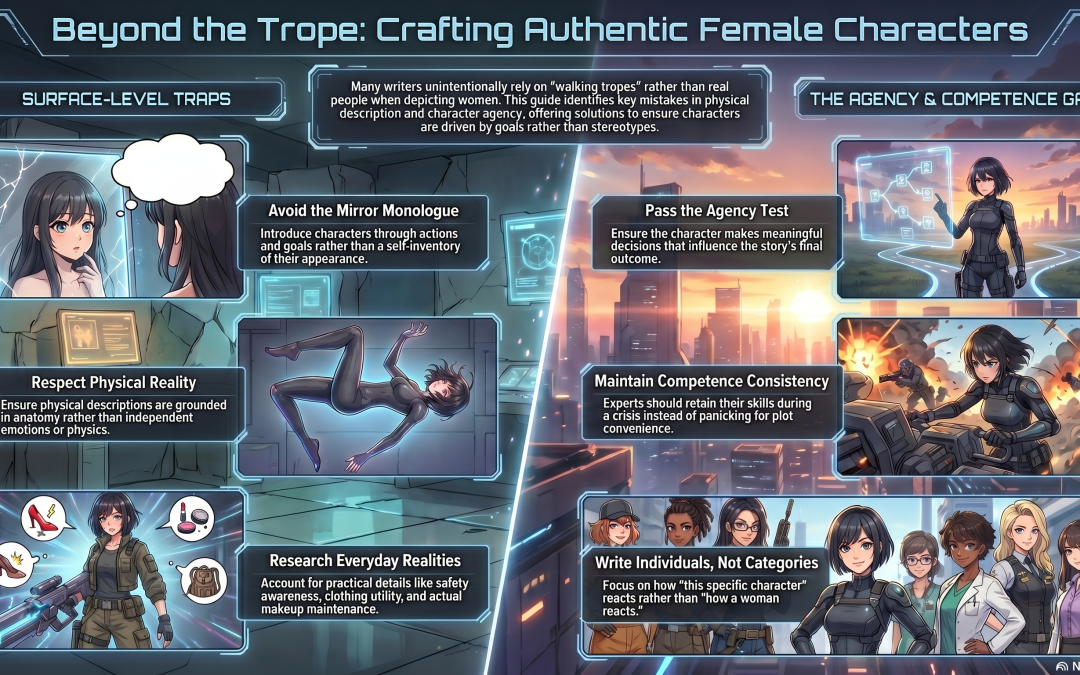
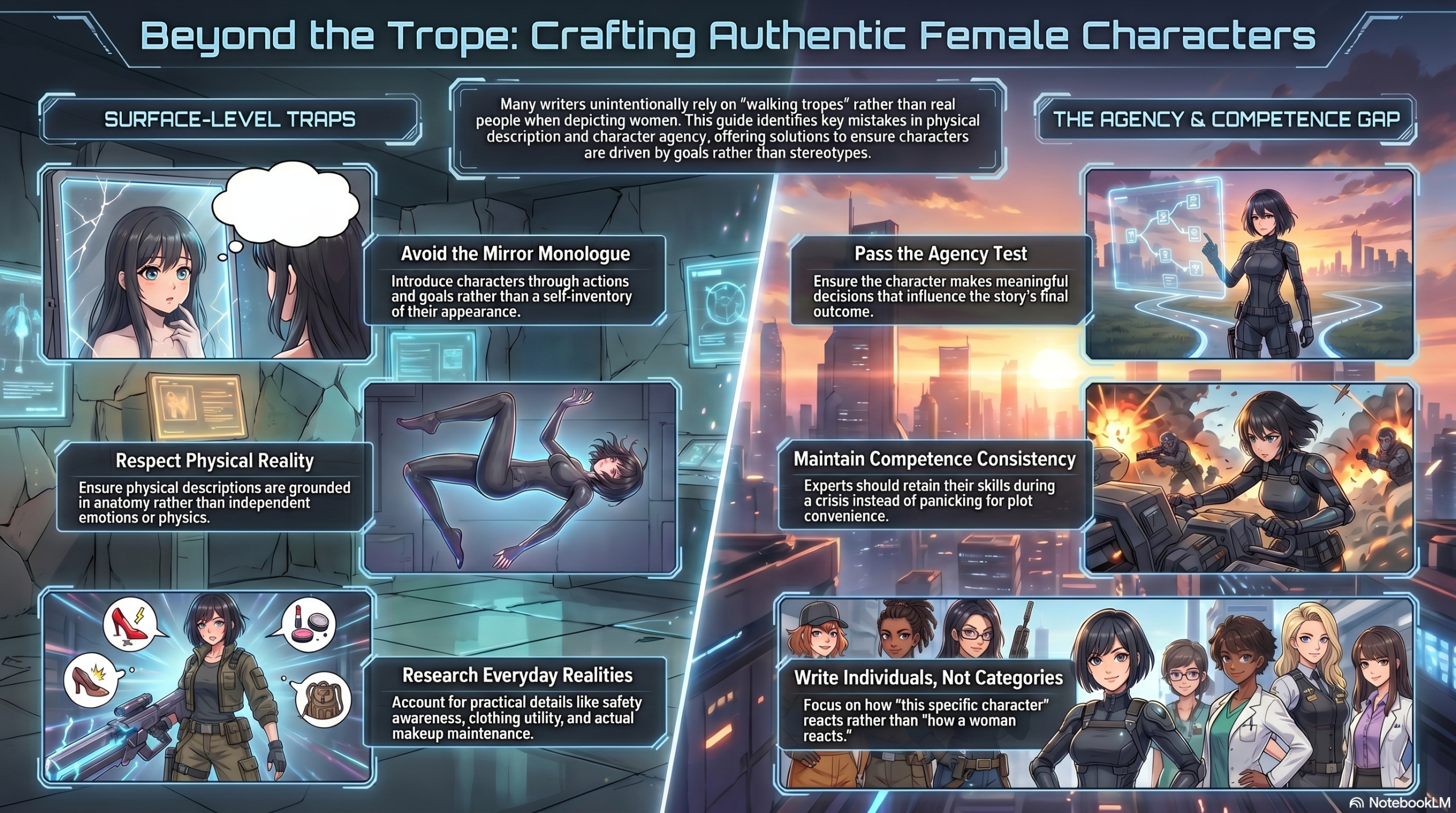
1. The Mirror Monologue Introduction
Instead of introducing a woman through her actions, goals, or personality, the writer places her half-dressed in front of a mirror. She then conducts a detailed inventory of her own appearance, cataloging every feature for the reader's benefit.
Most people don't stand around mentally listing their physical attributes. Readers can usually tell when a mirror scene exists solely to deliver a description.
A better approach is to reveal appearance naturally through action, dialogue, and observation while focusing first on who the character is and what she wants.
2. Defying the Laws of Physics and Anatomy
This is the source of countless "men writing women" memes.
The problem isn't describing a woman's body. The problem is describing it in ways that suggest you've never encountered one. If body parts seem to possess independent emotions, motivations, or gravitational fields, readers will notice.
Lines such as:
- "She breasted boobily down the stairs."
- "Her breasts bounced with excitement."
- "Her nipples stiffened with anger."
tend to draw laughter rather than immersion.
Describe the character as a whole person. Let physical descriptions serve the scene rather than dominate it.
3. Ignoring Everyday Female Experiences
Sometimes writers unintentionally reveal that they haven't researched experiences outside their own.
A common example is the woman wearing a full face of makeup who splashes water on her face, cries for twenty minutes, and somehow emerges looking flawless.
The issue isn't makeup specifically. It's a broader failure to understand everyday realities.
Whether you're writing about makeup, hair care, menstruation, pregnancy, clothing, safety concerns, or social expectations, a little research goes a long way. Readers don't expect perfection, but they do notice when basic details feel invented.
4. The "Man with Boobs" Problem
Some writers hear the phrase "strong female character" and respond by creating a stereotypical male action hero with different pronouns.
Strength is not a personality.
A female special-forces operator may be just as capable, brave, and competent as her male counterpart. However, she may face different assumptions, social pressures, expectations, or challenges throughout her life. Those experiences can influence how she earns trust, handles conflict, or views the world.
The goal isn't to make her less capable. It's to make her feel like an individual shaped by her own experiences.
5. Forgetting How Women Often Navigate Public Spaces
Many women move through the world with a level of awareness that men may not think about.
That doesn't mean every woman is constantly afraid. Some are reckless. Some are highly trained. Some deliberately ignore risks.
However, many women instinctively pay attention to exits, stay aware of who is nearby, avoid isolated areas at certain hours, or keep a phone readily accessible.
If your character casually wanders through situations that most people would view as risky, consider whether that behavior reflects her personality or whether the story has simply overlooked the issue.
6. Overreliance on Objectifying Descriptions
Some writers describe women almost exclusively through a sexualized lens.
Characters don't simply walk. They slink, sway, glide, or saunter. Their clothing is constantly clinging, stretching, hugging, or emphasizing various body parts.
Meanwhile, male characters are often described by their actions, skills, or decisions.
Ask yourself a simple question:
Would you describe a male character this way?
If not, reconsider what details truly matter in the scene.
7. Giving Her No Agency
A character without agency isn't a character. She's furniture.
This happens when a female character has no meaningful goals, makes no important decisions, and never influences the outcome of the story. She exists solely to be rescued, protected, kidnapped, avenged, or admired.
A useful test is this:
If you could replace her with a valuable object and the plot still works, she probably lacks agency.
Even supporting characters should make choices that affect events, succeed at some things, and fail at others.
8. Treating Other Women as the Enemy
A woman doesn't need a large circle of female friends to feel realistic.
The problem arises when every other woman in the story exists solely as a rival, obstacle, jealous competitor, or romantic threat.
Real women have friendships, mentors, coworkers, family members, allies, and rivals. Their relationships are just as varied and complicated as men's.
If every interaction between women revolves around competition for a man's attention, readers will notice.
9. Equating Beauty with Virtue
One of the oldest storytelling shortcuts is linking appearance directly to morality.
The beautiful woman is kind, innocent, and trustworthy.
The older woman is bitter.
The overweight woman is undesirable.
The unattractive woman is suspicious.
While individual examples can certainly exist, problems arise when the pattern becomes universal.
People are not good because they're attractive, and they aren't villains because they're aging. When beauty becomes a moral scorecard, characters start feeling artificial.
10. The Competence Collapse
You've seen this character before.
She's introduced as a renowned scientist, elite soldier, master detective, or brilliant executive. Everyone tells us how capable she is.
Then the crisis arrives.
Suddenly she freezes, panics, forgets everything she knows, and turns to the male protagonist to ask what happens next.
Competent characters shouldn't lose all competence simply because the plot needs someone else to shine.
Let them contribute ideas, solve problems, make mistakes, and take action. They don't have to save the day alone, but they should remain the person the story claimed they were.
Bonus: The Token Woman
Sometimes a story contains twenty named male characters and exactly one woman.
When that happens, the lone female character often ends up carrying the impossible burden of representing all women.
Women are not a personality type.
Just as male characters can be brave, cowardly, brilliant, foolish, kind, selfish, confident, insecure, or contradictory, female characters should display the same variety.
Representation becomes far more believable when multiple women exist in the story with different perspectives, strengths, flaws, and goals.
The Real Secret
Most of these mistakes come from asking the wrong question.
Writers often ask:
"How would a woman react?"
A better question is:
"How would this character react?"
Gender matters. Life experiences matter. Social expectations matter. But those things should add depth to a character, not replace one.
The best female characters aren't memorable because they're women.
They're memorable because they're specific people with goals, flaws, fears, talents, contradictions, and choices that drive the story forward.
If you focus on writing individuals rather than categories, you'll avoid most of these mistakes automatically.