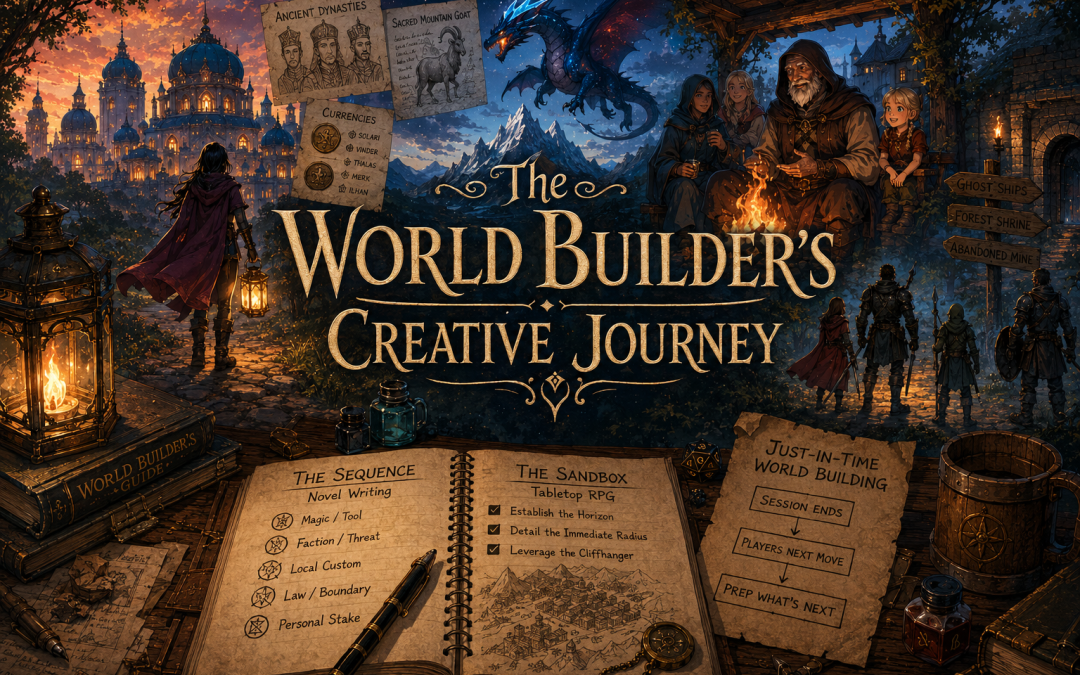
Every creator knows the siren song of worldbuilding. You set out to quickly name a local tavern, and four days later, you’ve mapped out three millennia of dynastic history, calculated exchange rates for five regional currencies, and written an essay on the migratory habits of a sacred mountain goat.
It’s fun, it’s immersive, and it feels like work—until you realize you haven’t written a single word of Chapter 1, or prepared a single encounter for your weekend game session.
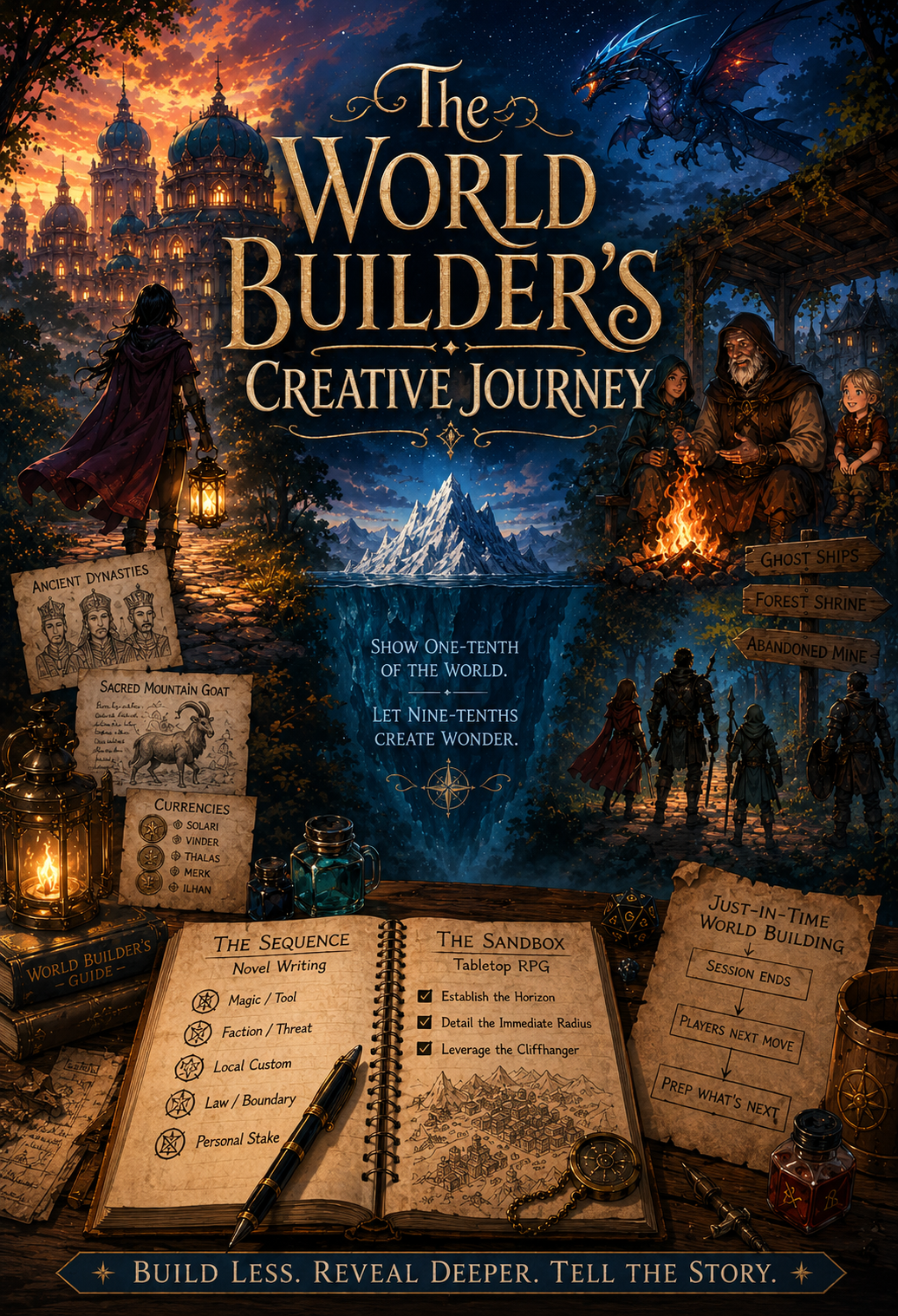
Ernest Hemingway famously described his writing style using the Iceberg Theory: show one-tenth of the world above the surface, and let the other nine-tenths sit underwater. Readers will naturally feel the weight of what’s underneath without needing to read a textbook about it.
To put Hemingway’s rule into practice, it helps to distinguish between two completely different worldbuilding frameworks: The Sequence and The Sandbox.
Pin This Post
1. The Novelist’s Path: Building for the "Sequence"
When you are writing a novel—whether it’s high-stakes urban fantasy, a cozy epic, or a mystery—your story moves in a Sequence. It is a curated, intentional journey.
Imagine your protagonist walking a narrow trail through a dense forest at dusk.
The reader can only see as far as the lantern light reaches.
They don't need a map of every tree in the kingdom; they only need to see the bend in the road ahead and catch a glimpse of shadow moving past the treeline.
Example from the Field:
When writing an urban fantasy Synapse Magic, the story hinges on high-stakes investigation and immediate magic mechanics around the "Radiant Fault." It would be easy to spend six chapters detailing the multi-century historical backstory of how magical theory evolved in this world. But in a fast-paced sequence, that kills momentum. The reader only needs to understand the immediate rules of magic as they touch the main character's choices right now. The deep backstory stays under the water line until the mystery demands it.
When you over-build for a novel, you end up stopping the action to explain the botany of the trees. Instead, focus on five deep anchors that directly touch your characters in the current arc:
- The Magic or Tool your protagonist actively relies on.
- The Faction or Threat actively pursuing them.
- The Local Custom that creates immediate friction in a scene.
- The Law or Boundary they are about to cross or break.
- The Personal Debt or Stake they cannot afford to lose.
2. The Game Master’s Realm: Building the "Sandbox"
If you run tabletop RPGs, you encounter a different challenge. Players don't follow a pre-paved path; they like to turn around, dig holes in the garden, and wander off toward whatever tavern rumor sounded interesting. For this, you need a Sandbox.
However, the "worldbuilder's trap" is even more dangerous for GMs. If you try to detail every town, NPC, and dungeon across an entire continent before Session 1, you’ll burn out before the dice ever hit the table.
The key to efficient Sandbox design is Just-in-Time Worldbuilding:
Establish the Horizon: Give players a clear sense of the regional geography and major factions so the world feels broad and alive.
Detail the Immediate Radius: Fully prepare only the town, dungeons, and NPCs where the players are starting.
Leverage the Cliffhanger: At the end of every game session, pause after the players announce their next big move.
Example from the Table:
In my tabletop campaigns, I might give players three broad hooks at the edge of town: a harbor plagued by ghost ships, a dark forest shrine, or an abandoned mountain mine. I don't build maps or stat blocks for all three before Session 1—that's wasted effort. Instead, I let them explore town, and when the session ends on a cliffhanger where they decide to head up into the mountains, that's when I spend my prep time detailing the mine for the following week.
The Golden Rule for GMs: Never design two weeks ahead of where your players can physically travel in one night.
3. The Power of "Unexplained Depth"
Whether you are writing fiction or prepping a campaign, the goal isn't to create a shallow puddle of endless facts—it's to create the illusion of infinite depth.
Consider these two approaches to historical lore:
Approach A: Three paragraphs explaining the precise troop movements, treaty dates, and economic causes of an ancient regional conflict.
Approach B: "The Compact ended the Salt Wars eighty years ago, but nobody along the border ever stopped keeping score."
Those nineteen words in Approach B do infinitely more heavy lifting than three paragraphs of exposition. They give the reader or player a tantalizing glimpse of the iceberg beneath the water, trusting their imagination to fill in the rest.
Bottom Line
Worldbuilding shouldn't be a prison that keeps you from finishing your draft or running your game. Give your audience just enough horizon to believe in the world, and then get back to telling the story.